Saturday, September 20, 2014

Scientists splice plants with bacteria to supercharge their growth

You don't need to be a farmer to know that weeds grow faster than potatoes. But scientists have been trying for a while to make slow-growing plants -- like wheat and rice -- perform more like fast crops, like corn and many weeds. The key is the way the crops photosynthesize, and some genetic splicing could trick slow plants into speeding up.

In a new study published in Nature, scientists borrowed genes fromphotosynthesizing bacteria -- which are quicker and more efficient at the process than many plants -- and grafted them into tobacco crops. So far, the researchers have only pushed the tobacco plants through two steps of the bacteria's three-part photosynthesis process. From MIT Technology Review:
First, proteins form a special compartment within a plant cell that concentrates CO2; second, the compartment contains a speedy enzyme for converting that CO2; and third, the cells use special pumps in their membranes to usher CO2 into the cells.
Earlier this year, the researchers engineered cells to form the special CO2 compartments. The new research takes care of the second part—the speedy enzyme. They’re collaborating with other researchers on the third part, the pumps. Ultimately the researchers will need to put all three parts together in the same plants.
In fact, PopularMechanics reports, the genetically engineered tobacco in this experiment actually grew more slowly than natural plants, because it only produced the special enzyme -- without those compartments or pumps. To make it grow faster, the researchers need to combine all three steps.
For this reason, commercial crops grown with these alterations are probably at least a decade off. But eventually, the researchers say, these changes could boost crop yields by as much as 60 percent for some plants -- and allow farmers to use less water and fertilizer in the process.
Washington Post:
http://www.washingtonpost.com/news/speaking-of-science/wp/2014/09/18/scientists-splice-plants-with-bacteria-to-supercharge-their-growth/

Friday, September 19, 2014

Could Fighting Global Warming Be Cheap and Free?

This just in: Saving the planet would be cheap; it might even be free. But will anyone believe the good news?
I’ve just been reading two new reports on the economics of fighting climate change: a big study by a blue-ribbon international group, the New Climate Economy Project, and a working paperfrom the International Monetary Fund. Both claim that strong measures to limit carbon emissions would have hardly any negative effect on economic growth, and might actually lead to faster growth. This may sound too good to be true, but it isn’t. These are serious, careful analyses.
But you know that such assessments will be met with claims that it’s impossible to break the link between economic growth and ever-rising emissions of greenhouse gases, a position I think of as “climate despair.” The most dangerous proponents of climate despair are on the anti-environmentalist right. But they receive aid and comfort from other groups, including some on the left, who have their own reasons for getting it wrong.
More

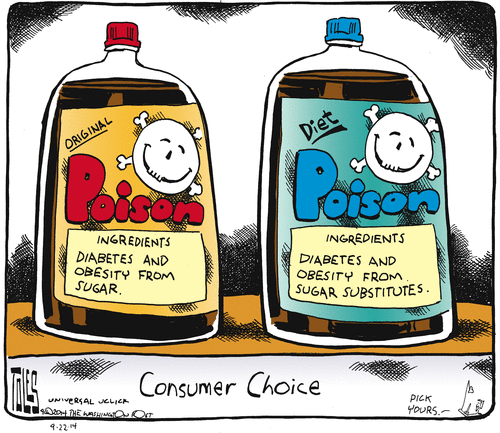
Artificial Sweeteners May Disrupt Body’s Blood Sugar Controls


Sweeteners alter the microbiome, the population of bacteria that is in the digestive system.

Credit Weizmann Institute of Science
Artificial sweeteners may disrupt the body’s ability to regulate blood sugar, causing metabolic changes that can be a precursor to diabetes, researchers are reporting.
That is “the very same condition that we often aim to prevent” by consuming sweeteners instead of sugar, said Dr. Eran Elinav, an immunologist at the Weizmann Institute of Science in Israel, at a news conference to discuss the findings.
The scientists performed a multitude of experiments, mostly on mice, to back up their assertion that the sweeteners alter the microbiome, the population of bacteria that is in the digestive system.
The different mix of microbes, the researchers contend, changes the metabolism of glucose, causing levels to rise higher after eating and to decline more slowly than they otherwise would.
...
In the initial set of experiments, the scientists added saccharin (the sweetener in the pink packets of Sweet’N Low), sucralose (the yellow packets of Splenda) or aspartame (the blue packets of Equal) to the drinking water of 10-week-old mice. Other mice drank plain water or water supplemented with glucose or with ordinary table sugar. After a week, there was little change in the mice who drank water or sugar water, but the group getting artificial sweeteners developed marked intolerance to glucose.
Glucose intolerance, in which the body is less able to cope with large amounts of sugar, can lead to more serious illnesses like metabolic syndrome and Type 2 diabetes.
When the researchers treated the mice with antibiotics, killing much of the bacteria in the digestive system, the glucose intolerance went away.
...
More 
Deeper
Original Article


Thursday, September 18, 2014

Fighting Poisons With Bacteria

Going Inside the Rice Microbiome


When Harsh Bais grows rice plants in trays of water in his greenhouse at the University of Delaware, he can easily spot the ones that have been exposed to arsenic: They are stunted, with shorter stems and shrunken, yellow-tinged leaves.
Dr. Bais is working to develop rice plants that take up less arsenic, a common contaminant in the fields of his native India and other Asian countries. Chronic exposure to arsenic has been linked to heart disease, diabetes and genetic damage associated with elevated risk for cancer.
But instead of trying to breed new strains of rice or alter its DNA, he and other scientists have set out in a surprising new direction. They are looking at the vast and untapped microbial community that lives near the rice’s roots.
These bacteria are the botanic equivalent of the human microbiome — the trillions of organisms that live in our guts, many performing beneficial tasks like digesting food and fighting off infection.
The hope is to find bacteria that will somehow block arsenic in its path from soil to roots to stem to edible grain. In the past three years, Dr. Bais has isolated about a dozen bacterial species, added them to plants in the greenhouse and looked for the telltale signs of arsenic poisoning.
Now, he says, he has zeroed in on one species, Pantoea agglomerans, that seems to reduce arsenic in the plant’s stem to one-eighth its former levels.

More

Found by Katie

Tuesday, September 16, 2014

U.S. to Commit Up to 3,000 Troops to Fight Ebola in Africa

WASHINGTON — Under pressure to do more to confront the Ebola outbreak sweeping across West Africa, President Obama on Tuesday is to announce an expansion of military and medical resources to combat the spread of the deadly virus, administration officials said.
The president will go beyond the 25-bed portable hospital that Pentagon officials said they would establish in Liberia, one of the three West African countries ravaged by the disease, officials said. Mr. Obama will offer help to President Ellen Johnson Sirleaf of Liberia in the construction of as many as 17 Ebola treatment centers in the region, with about 1,700 treatment beds.
Senior administration officials said Monday night that the Department of Defense would open a joint command operation in Monrovia, Liberia, to coordinate the international effort to combat the disease. The military will also provide engineers to help construct the additional treatment facilities and will send enough people to train up to 500 health care workers a week to deal with the crisis.


PLAY VIDEO|3:47

Dying of Ebola at the Hospital Door


Dying of Ebola at the Hospital Door

Monrovia, the Liberian capital, is facing a widespread Ebola epidemic, and as the number of infected grows faster than hospital capacity, some patients wait outside near death.
 Video CreditBy Ben C. Solomon on Publish DateSeptember 11, 2014. 
more
video

U.N. Sees Need for $1 Billion to Fight Ebola

GENEVA — The Ebola virus outbreak in West Africa risks ballooning into a humanitarian catastrophe without a major surge in international efforts to contain it, senior United Nations officials said Tuesday, estimating the cost of this effort at $1 billion.
The number of people affected by the disease is still rising “almost exponentially,” Bruce Aylward, an assistant director general of the World Health Organization, said at a news conference in Geneva. He said the number of reported cases had climbed to 4,985, including 2,461 deaths. Half of the infections and deaths occurred in the past 21 days, he said, underscoring the acceleration of the outbreak. “We don’t really know where the numbers are going with this,” Mr. Aylward said.
road map he announced nearly three weeks ago to guide the international response had called for the capacity to manage 20,000 cases, but “that does not seem like a lot today,” he said.
“The numbers can be kept in the tens of thousands,” he said, “but that is going to require a much faster escalation of the response if we are to beat the escalation of the virus.”
More


 Will the Ebola virus go airborne?

Could Ebola go airborne? That’s the fear set off last week by a New York Times op-ed entitled “What We’re Afraid to Say about Ebola” from Michael Osterholm, director of the Center for Infectious Disease Research and Policy at the University of Minnesota. Although clinicians readily agree that the Ebola virus leaps from one person to the next via close contact with blood and other bodily fluids, Osterholm warned that the risk of airborne transmission is “real” and “until we consider it, the world will not be prepared to do what is necessary to end the epidemic.”
But interviews with several infectious diseases experts reveal that whereas such a mutation — or more likely series of mutations — might physically be possible, it’s highly unlikely. In fact, there’s almost no historical precedent for any virus to change its basic mode of transmission so radically. “We have so many problems with Ebola, let’s not make another one that, of course, is theoretically possible but is pretty way down on the list of likely issues," says infectious diseases expert William Schaffner of Vanderbilt University.
"Everything that is happening now can easily be comprehensively explained by person-to-person spread via body contact. We don’t have to invoke anything else.”
Here is what it would take for it to become a real airborne risk: First off, a substantial amount of Ebola virus would need to start replicating in cells that reside in the throat, the bronchial tubes and possibly in the lungs. Second, the airborne method would have to be so much more efficient than the current extremely efficient means of transmission that it would overcome any genetic costs to the virus stemming from the mutation itself
Currently, Ebola typically gains entry into the body through breaks in the skin, the watery fluid around the eye or the moist tissues of the nose or mouth. Then it infects various cells of the immune system, which it tricks into making more copies of itself. The end result: a massive attack on the blood vessels, not the respiratory system.


Sunday, September 14, 2014

Should We All Take a Bit of Lithium?


THE idea of putting a mind-altering drug in the drinking water is the stuff of sci-fi, terrorist plots and totalitarian governments. Considering the outcry that occurred when putting fluoride in the water was first proposed, one can only imagine the furor that would ensue if such a thing were ever suggested.
The debate, however, is moot. It’s a done deal. Mother Nature has already put a psychotropic drug in the drinking water, and that drug is lithium. Although this fact has been largely ignored for over half a century, it appears to have important medical implications.
Lithium is a naturally occurring element, not a molecule like most medications, and it is present in the United States, depending on the geographic area, at concentrations that can range widely, from undetectable to around .170 milligrams per liter. This amount is less than a thousandth of the minimum daily dose given forbipolar disorders and for depressionthat doesn’t respond toantidepressants. Although it seems strange that the microscopic amounts of lithium found in groundwater could have any substantial medical impact, the more scientists look for such effects, the more they seem to discover. Evidence is slowly accumulating that relatively tiny doses of lithium can have beneficial effects. They appear to decrease suicide rates significantly and may even promote brain health and improve mood.
More

Friday, September 12, 2014

Mining for Antibiotics, Right Under Our Noses

“Microorganisms are the best chemists on the planet,” declaredMichael A. Fischbach, a chemist himself at the University of California, San Francisco.
For evidence, Dr. Fischbach points to the many lifesaving drugs that microorganisms produce. In 1928, for example, Alexander Fleming discovered that mold wafting into his lab produced a bacteria-killing chemical that he dubbed penicillin.
Later generations of scientists found drugmaking microorganisms in more exotic locales. In 1951, a missionary in Borneo named William Bouw shipped a box of jungle dirt to Edmund C. Kornfield, a chemist at Eli Lilly. In that soil, Dr. Kornfield discovered a species of bacteria that made a potent antibiotic, later named vancomycin.
Scientists today are still searching jungles, oceans and other corners of the world for microorganisms that make medicines. But in a new studypublished Thursday in the journal Cell, Dr. Fischbach and his colleagues suggest that we should also be looking inward.
Analyzing the bacteria that live in our bodies, the scientists identified genes for making over 3,000 previously unknown molecules that may prove to be useful drugs.
“Nobody had thought to look that close to home,” said Dr. Fischbach.
Finding these small molecules — known as natural products — has traditionally been a slow affair. Microbes typically make natural products in exquisitely tiny amounts, and they don’t rely on a single gene to do so. Instead, microbes need dozens of different proteins made by different genes to craft a natural product.
Dr. Fischbach and his colleagues set out five years ago to speed up the search. They wrote a software program that learns how to recognize the genes for natural products.
Those genes tend to sit together in a cluster in a microbe’s DNA, and they are very similar to one another. By shuffling them into different combinations, microbes can produce a staggering range of molecules.
To train the software, Dr. Fischbach and his colleagues introduced it to 732 gene clusters that are already known to make natural products. As the software examined cluster after cluster, it came to recognize distinctive patterns. Eventually the program got so good that it could accurately pinpoint new gene clusters in DNA sequences it had never encountered before.
The scientists wondered what would happen if they turned their well-educated computer loose on the microbes that live in our bodies.
They provided it with a vast genetic library created in an ongoing study called the Human Microbiome Project. The project scientists have collected microbial DNA from five different body sites on 242 healthy volunteers. From that genetic material, they were able to sequence the entire genomes of 2,340 different microbial species, most of which were new to science.
Searching those genomes, the computer spotted more than 14,000 gene clusters for natural products. Dr. Fischbach and his colleagues tossed out the gene clusters that were present in only a few people. They were left with 3,118 common ones.
Their study suggests that the human microbiome is a rich source of previously unknown natural products.
“That wasn’t where I expected to find interesting drug-producing genes,” said Dr. Fischbach. “I was really taken aback.”
To show the potential medical value of these genes, Dr. Fischbach and his colleagues picked out a single cluster to study more closely. It belongs a species of bacteria called Lactobacillus gasseri. They reared huge numbers of the bacteria in the laboratory in order to isolate a speck of one its products, which they dubbed lactocillin.
They found that its structure is similar to a recently discovered antibiotic called LFF571, which the drug company Novartis is now testing in clinical trials. When Dr. Fischbach and his colleagues exposed several species of bacteria to lactobacillin, the microbes died, suggesting that it might also be a good antibiotic.
The idea that our own bacteria are making potent antibiotics may seem strange. If the microbiome is churning out poison, how does it avoid killing itself?
Dr. Fischbach suspects that bacteria only use antibiotics sparingly against their competition. “You don’t wipe the slate clean of bacteria around you,” he said. “This could be something that a hundred thousand microbes use to guard the border of their colony.”
Shaun Lee, a microbiologist at University of Notre Dame who was not involved in the study, said that the fierce competition going on inside our bodies makes it a good place to look for antibiotics. “The human body is the Manhattan of microbial living — a great place to live with plenty of resources,” he said. “But real estate is at a premium.”
A lot of the natural products made by the microbiome may not be antibiotics. Previous studies have shown that some act as signals between microbes. Some even let microbes influence their human hosts.
Since these molecules carry out many jobs for microbes, it may be possible to turn them into drugs besides antibiotics. Consider statins, the drugs commonly prescribed to lower cholesterol. In 1972, the biochemist Akira Endo discovered the first statin in a mold that infects rice.
Of course, the history of research on natural products is also littered with failed molecules that never reached the market because they turned out to be ineffective or even dangerous. While Dr. Fischbach acknowledged that many of the microbiome’s natural products may also fail, he suggested that they might be particularly good molecules to turn into drugs.
For one thing, they’re made by microbes that have adapted to living inside of us for millions of years. Some of them may make natural products that latch precisely onto our own cells in medically useful ways.
The microbiome’s natural products may also be more likely to be safe. After all, microbes pump these molecules into our bodies every day without any apparent harm.
“This might be a privileged set of molecules,” said Dr. Fischbach.